


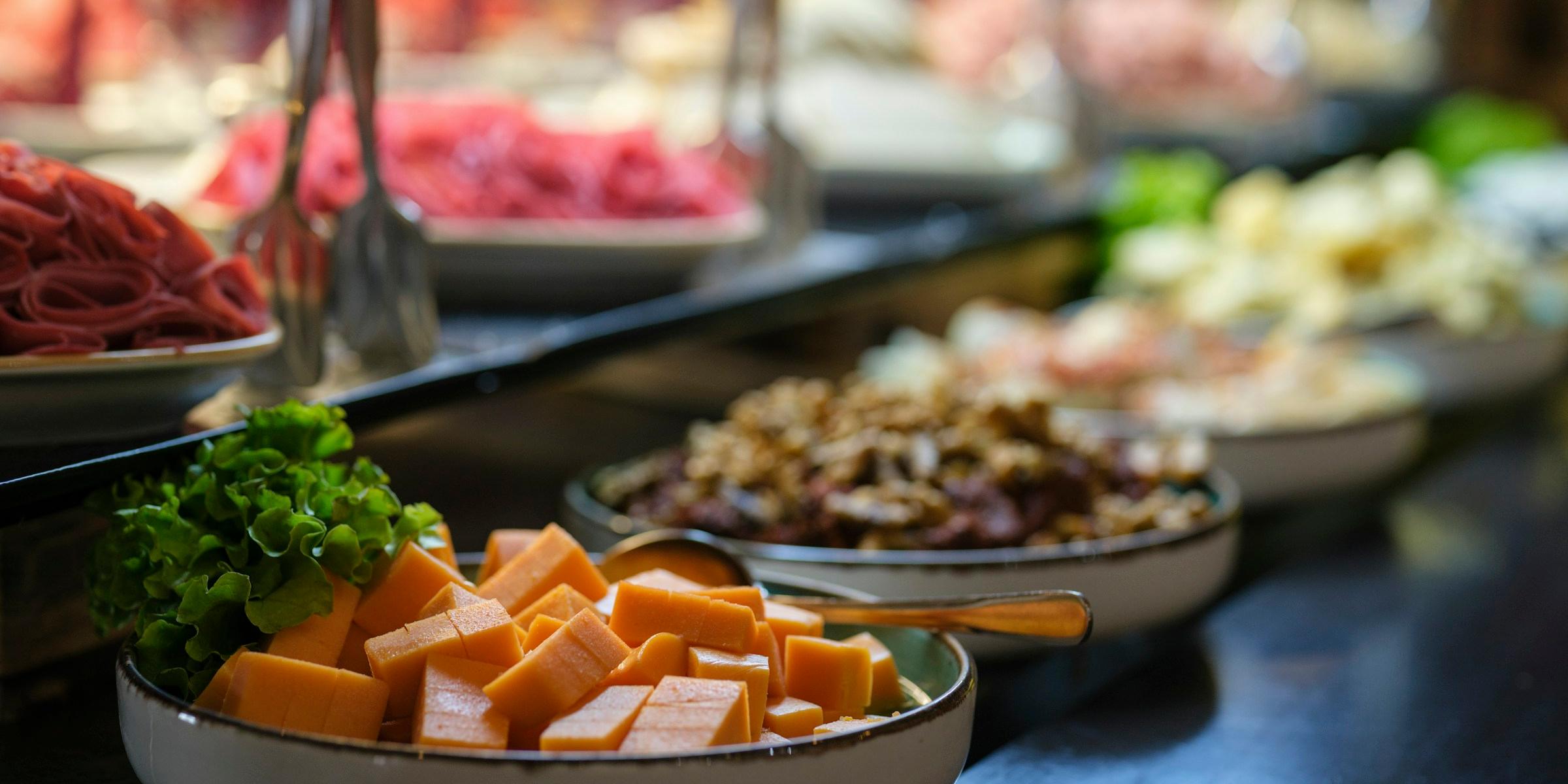
A hotel’s buffet-style breakfast is the service that offers the widest variety of items but requires the least preparation time. The buffet, which closes in the evening, must be set up again the next morning at 6:30 a.m. exactly as it was before—and the selection changes every day. That’s why stocking the buffet isn’t a matter of following a checklist; it’s a matter of rhythm.
In this guide, we’ve compiled information on which stations make up the buffet, which items should be served in individual portions and which in bulk packaging, how to calculate the amount per person, and where waste occurs. We have been supplying hotel kitchens in Istanbul since 1995; most of the distinctions below stem from that operation.
How many stations are there in a buffet-style breakfast?
A standard hotel breakfast buffet consists of six stations, and each station has a different packaging option. Creating the list station by station is both faster than keeping a single “breakfast list” and helps you forget fewer items when ordering.
| Station | Typical content | Packaging preference |
|---|---|---|
| Cheese | White, Cheddar, fresh, cream cheese, labneh | In bulk — the chef slices and arranges them |
| Deli | Sucuk, salami, ham, smoked turkey | Sliced or buffet-sized |
| Olives & Salad | Black/green olives, tomatoes, cucumbers | Bulk bucket/can |
| Breakfast Items | Butter, honey, jam, chocolate spread | Served in individual portions—guests help themselves |
| Hot Buffet | Eggs, sausages, potatoes, vegetables | Bulk preparation, ready for service |
| Beverages | Tea, coffee, milk, fruit juice, plant-based milk | Mixed bulk and single-serving portions |
The practical benefit of this distinction is that in hotels that organize their order lists by station, the number of missing items drops significantly, because the person setting up the buffet and the person placing the order speak the same language.
In what order is the buffet set up?
The serving order described in the Ministry of National Education’s buffet-style module is as follows: cold dishes, salads, hot dishes, desserts and pastries, and beverages. The same principle applies to the breakfast buffet—cold items first, hot items last, and beverages at the very end.
The reason is both hygiene and workflow: products requiring a cold chain wait for a shorter time at the front of the line, while hot items are grouped near the warming tray. The same source mentions two things regarding hot items: preparing them as close to serving time as possible and having a hot holding device (such as a chafing dish) available at the buffet.
Temperature values are determined in accordance with the facility’s own HACCP plan and inspection guidelines; we do not provide specific numbers here because the source document does not specify them. Use the thresholds in your own plan as a guide.
Single-serving or bulk packaging?
The rule, in a nutshell, is this: items that guests take and open themselves should be individually portioned, while items prepared and arranged by the chef should be in bulk packaging.
The main benefit of single-serving packaging at the buffet isn’t the price— it’s the waste: an unopened single-serving portion can be served the next day, whereas a product placed in an open container cannot. In contrast, for cheese platters, olives, and the hot buffet, single-serving packaging both increases costs and detracts from the buffet’s appearance.
| Pen | Individual (served to guests) | Bulk (prepared by the chef) |
|---|---|---|
| Butter | 10 g × 200 · 10 g × 192 | 1 kg block |
| Honey | 30 g × 24 · 15 g × 100 | 5 kg bucket |
| Jam | Strawberry 15 g × 100 · Apricot 15 g × 100 | 5/1 box |
| Cream cheese | 15 g × 200 | 2.5 kg tub |
| Labne | 20 g × 120 | 2.5 kg tub |
When making a decision, consider the number of guests: individual portions are more economical for small gatherings, while bulk packaging is more economical for large ones. A 5-kg jar of honey opened for a 40-person breakfast will most likely result in waste; at a 300-person buffet, 15-gram containers will multiply both the cost and the waste.
How is the per-person amount calculated?
At the buffet, the correct amount per person isn’t based on the industry average—it’s based on your own past consumption. The “X grams per person” tables circulating online can vary from business to business—ranging from double to half the amount—and the guest profile, length of stay, and number of items at the buffet can completely change the result.
The process consists of three steps:
- Measure for two weeks. Every morning, record the amount of food taken from the buffet and the amount returned at the end of the service, item by item. The difference is your actual consumption.
- Divide by the number of people. You’ll end up with a per-person figure—this figure is specific to your hotel.
- Multiply by the occupancy estimate. Orders are placed based on next week’s reservations, not last week’s consumption.
Hotels that conduct this audit once usually discover two things: a few items are consistently overstocked, and one or two items are constantly running out early. Correcting these two issues yields greater savings than switching suppliers.
How do you set up a cheese platter?
A good breakfast cheese platter isn’t defined by the number of varieties, but by the variety of textures: a salty, brined cheese, a melty yellow cheese, a soft or creamy cheese, and one that “stands out.”
- Brine base: White cheese is a staple of the buffet; the salt balance is adjusted based on the guest profile.
- Yellow cheese: Kaşar works well both on a plate and at the toast station.
- Soft cheeses: fresh cheese, cream cheese, and labneh add substance to a plate without weighing it down.
- The touch that makes a difference: at boutique hotels, it’s often a single special cheese that sets the plate apart from the competition.
The entire selection of cheeses is in the “Cheeses” category. We’ve explained which types of mozzarella are used where in our mozzarella guide, and how to serve and store burrata in our burrata guide.
What changes on a charcuterie platter?
At the deli, what determines the display isn’t the product itself, but whether it comes pre-sliced. Sliced products maintain a consistent portion size and don’t require additional labor in the kitchen; whole products are more economical but require staff and equipment to slice them every morning.
Formats designed for the buffet make things easier: buffet-sized sausage and serving-sized sausage are packaged specifically for this purpose. In the sliced section, smoked turkey, beef ham, and Hungarian salami are commonly used. The entire group falls under the Breakfast & Deli category.
What does “caliber” mean when it comes to olives?
Numbers such as “201–230” on olive packaging indicate the number of olives per kilogram; as the number increases, the olives become smaller. At the buffet, this is immediately apparent: the small-caliber bowl looks full, while the large-caliber one looks more impressive but empties faster.
A practical approach is to use two sizes together: medium-sized for black olives and small-sized for green cocktail olives. For busy buffets, 10-kg packages significantly reduce the unit cost. The entire range is available in the Olives & Olive Oil category.
Specialized dietary options are now the norm
Plant-based milk, sugar-free jam, and gluten-free bread are no longer considered “extras”—they’re now a standard part of any breakfast buffet. It leaves a worse impression when a guest asks but can’t find what they’re looking for than when they find it but don’t like it.
Three ways to cut costs: adding oat milk to the coffee station, stocking diabetic-friendly jam in the jam section, and choosing single-serving products with legible label information. We compared how different plant-based milks behave in coffee in our plant-based milk guide.
Where do inventory discrepancies occur at the buffet?
At the breakfast buffet, waste accumulates in three areas, all of which are related to procurement decisions:
- In the opened container: when a large package is opened but not finished. The solution is to choose the package size based on the amount of product.
- Excess food on the buffet: the bowl filled for the last guest often comes back. The solution is to switch to smaller containers toward the end of the meal.
- In the warehouse: weekly restocking of products with a short shelf life. Solution: 2–3 small deliveries per week for the fresh category, and one large monthly delivery for the dry goods category.
The third point relates directly to the supplier. Since we make deliveries to Istanbul’s 39 districts six days a week using our own vehicles, it’s possible to reduce the days of inventory for fresh products—which means you can really make the most of your cold storage space.
Order frequency based on inventory levels
Sorting items into two categories alone improves inventory turnover: Items directly tied to inventory levels (dairy products, cheese, deli meats, fresh items) are ordered based on weekly reservations; items not tied to inventory levels (tea, coffee, jam, honey, consumables) are ordered on a monthly basis.
Banquet and meeting arrangements should be planned separately from these two groups—since they are one-time events and involve large volumes, if they are included in the daily list, either items will be missing or excess inventory will remain. We’ve covered all aspects of hotel catering on our page about wholesale food supply for hotels.
Ordering and Delivery
Santral Gıda has been providing exclusively corporate supply services since 1995; it makes deliveries to Istanbul’s 39 districts six days a week using its own vehicles, and products requiring a cold chain are transported in refrigerated vehicles. We do not offer retail sales or online payment; prices are determined on a quote basis, and special pricing is applied based on quantity.
Share your buffet menu, and we’ll prepare a written quote that includes exact equivalents and alternatives. You can review all the items in our catalog and contact us for a quote.
Source note
The buffet service sequence and rules for preparing hot items are taken from the Ministry of National Education’s MEGEP “Buffet” module. Temperature thresholds and per-person weight values have been intentionally omitted from this document: they are not included in the source document and vary from establishment to establishment. Use the thresholds in your own HACCP plan and your own measured consumption data as a basis. The product label is the authoritative source for product specifications.


