

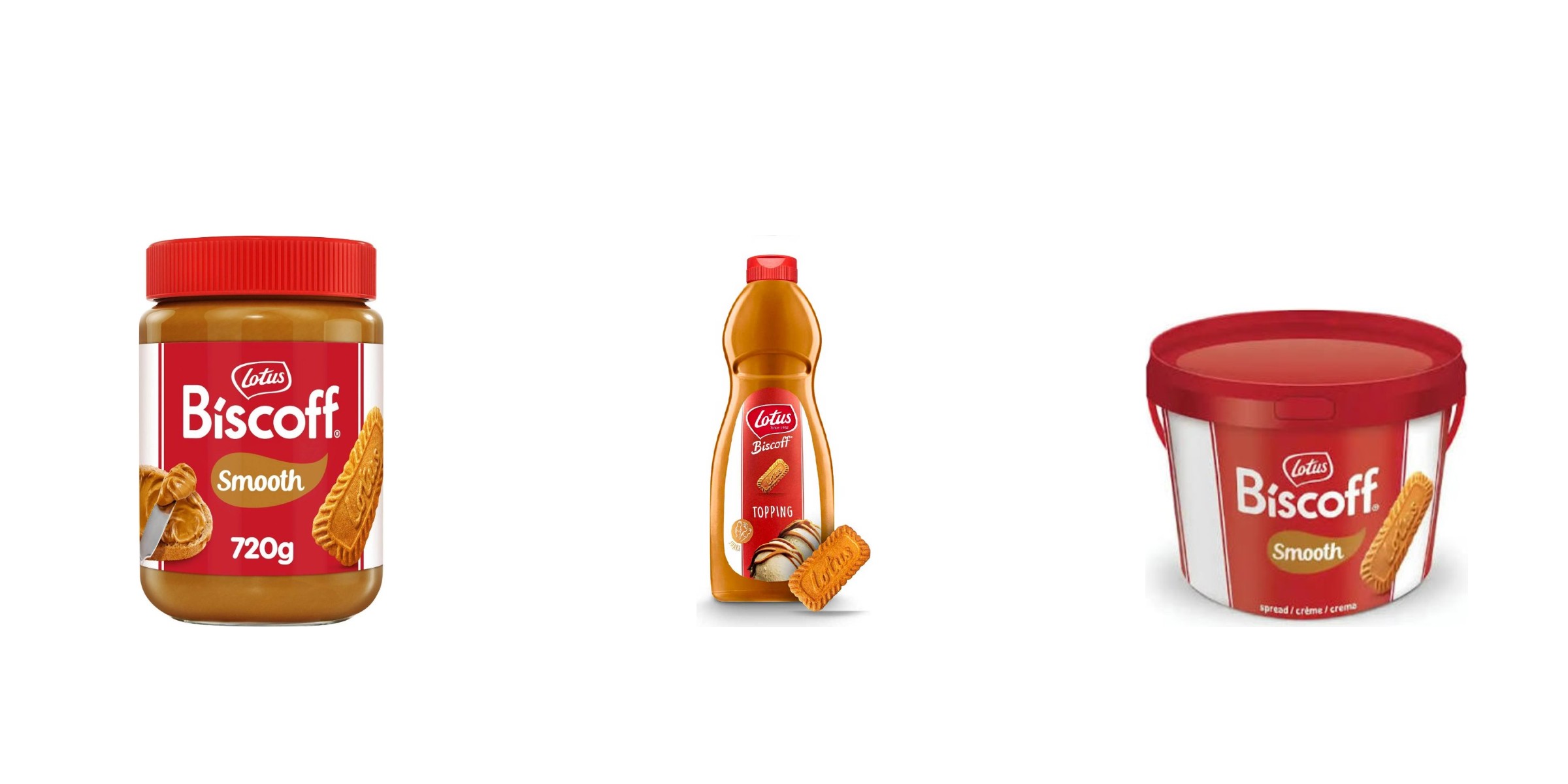
In short: Lotus Biscoff’s four formats are all made from the same caramelized cookie, but they are not interchangeable. The cream (58% cookie) is incorporated into the recipe, the topping (52% cookie) is added on top at the time of serving to provide a crumbly texture, and the whole cookie remains on the plate. Below are the technical differences between the formats, a table of packaging and shelf life, Lotus’s own recipe ratios, and brand usage guidelines that most businesses are unaware of.
- The cream contains 58% and the topping 52% biscuit — the difference isn’t just in texture, but also in density.
- Before using the 8-kg bucket, it should be heated to 40–50 °C and stirred. It does not require a 1.6 kg jar.
- The shelf life varies by format: crumb, 7 months; cream/topping, 12 months; 1.6 kg jar, 13 months.
- The entire product line is 100% vegan and contains no artificial colors, flavors, or preservatives; all products contain gluten.
- There are rules for listing “Biscoff” on the menu —Lotus defines them in writing, and most businesses violate them.
What is Biscoff, and where does its flavor come from?
Biscoff is a caramelized cookie first produced in 1932 by Jan Boone Sr. in the town of Lembeke, Belgium. The manufacturer notes that the cookie has been produced in the same town for over 90 years. The brand name says it all: According to Lotus’s own explanation, the word “Biscoff” is a combination of the words “biscuit” and “coffee.”
From a professional culinary perspective, the key point is this: this flavor comes not from spices, but from the caramelization of sugar. Lotus states that, in its own words , “the real magic in cooking lies in the skillfully managed caramelization process,” and notes that the recipe has remained unchanged since 1932 and that the product contains no artificial flavors or colorings. That’s why it’s misleading to think of Biscoff as a “cinnamon cookie”; its flavor profile leans toward caramel, which is why it pairs so well with roasted coffee.
Four formats, four distinct projects
The most common mistake is using cream and topping interchangeably. They are two different products, and even the proportions of cookies used in each are different.
| Format | Biscuit ratio | Texture | Serving time | Misuse |
|---|---|---|---|---|
| Cream (Spread) | 58% | Thick, spreadable | Used in: fillings, layers, milkshake bases | Drizzle as a sauce — does not run without heating |
| Topping sauce | 52% | Fluid, spreadable | Top on the drink at the time of service: latte, ice cream, waffle | Filling between layers — spreads easily |
| Crumble | The cookie itself | Crispy pieces | Cheesecake crust, topping, layer | Leaving it exposed in a humid environment — it will clump |
| All the cookies | — | Crispy, whole | Perfect with coffee, for breakfast, or as a plate presentation | — |
There’s one detail the manufacturer emphasizes about the crumbs: the crumbs “retain their crisp texture because they’re crushed after baking” and “are ready to use—you won’t waste time grinding the cookies yourself.” When you grind your own cookies, the particle size varies from batch to batch; with ready-made crumbs, it remains consistent.
Which package should you choose?
Short answer: The largest package size isn’t always the most economical. An 8-kg bucket lowers the unit cost but comes with two drawbacks—the need to heat it before use and a shorter shelf life.
| Product | Packaging | Shelf Life | Before Use | Who it’s for |
|---|---|---|---|---|
| Smooth Cream 8 kg | Bucket | 12 months | Heat to 40–50 °C, stir | Bakeries, chain cafes, high-volume production |
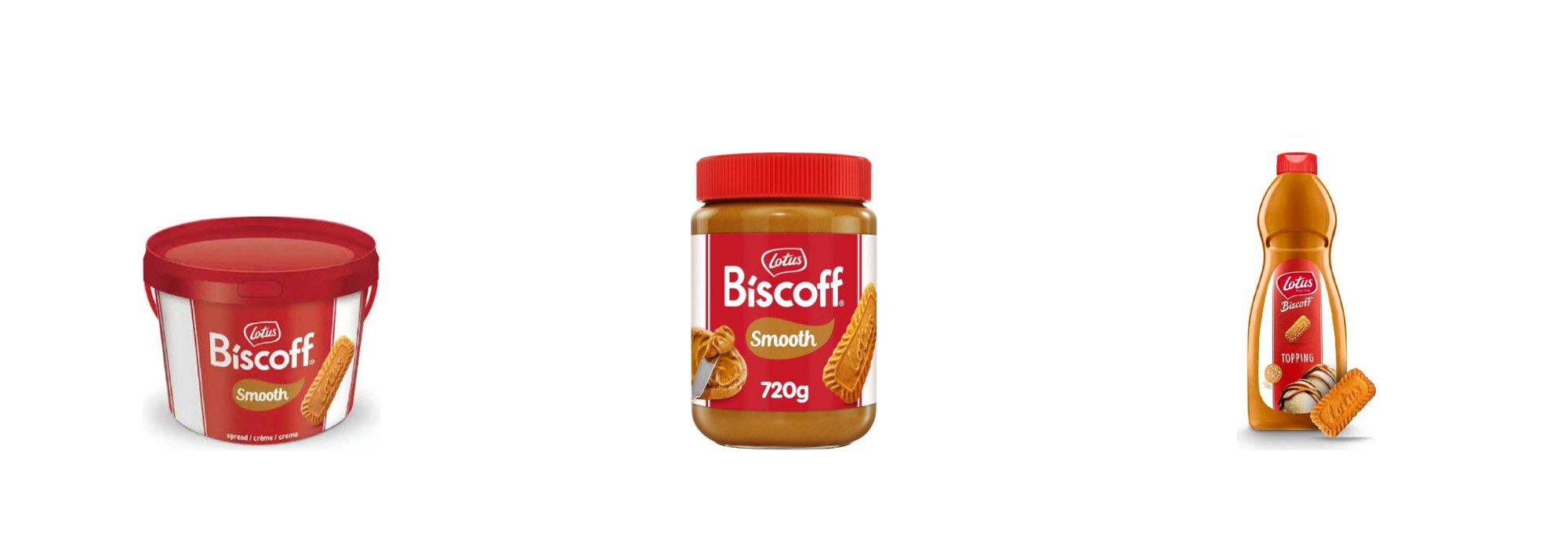
| Spread Original 1600 G | PET jar | 13 months | Mix | Medium volume, point of service |
| Spreadable Spread 720 g | Glass jar | — | Mix | Boutique café, breakfast presentation |
| Topping Sauce 1 KG | Squeeze bottle | 12 months | Shake well | Barista counter, dessert service |
| Crumble 7.5 kg | Box | 7 months | Ready to use | Cheesecake crust, topping |
| Biscuits 250 g | Package | — | — | To go with coffee, hotel breakfast |
The 7-month shelf life of the crumbs is the shortest in the product line —plan your use of the 7.5-kg box based on your consumption rate. All products should be stored in a dry place away from heat, at room temperature; refrigeration is not required.
Why has the tradition of serving snacks with coffee become so deeply ingrained?
This isn’t a marketing gimmick—it’s a 70-year-old tradition. According to Lotus’s own history, the cookie was introduced to the food industry in 1956 as a “cookie to be served with coffee,” and when it began to be individually wrapped in the 1950s, it was “immediately embraced by cafes and restaurants.”
The manufacturer explains the rationale as follows: “The flavor profiles of roasted coffee and our caramelized cookies complement each other; it has been scientifically proven that they enhance each other’s flavor.” This statement comes from Lotus; the company does not disclose which study it is based on, so it is appropriate to consider this as the manufacturer’s claim.
From a business perspective, the practical value is this: individually wrapped cookies are a hygienic and visually appealing treat with a predictable cost per cup . Lotus describes this as “an opportunity to show each of your customers personal attention. “
How do I add it to the menu? Channel by channel
Lotus positions its professional product line according to four channels. The recommendations below are compiled from the manufacturer’s own channel pages.
| Business Type | Lotus’s recommended use | Primary product |
|---|---|---|
| Café & Bistro | A cookie with every cup; adding cream to a latte; topping a frappe | Cookie + cream + topping |
| Pastry Shop & Bakery | Cupcakes, cheesecake crusts, pastry toppings | Crumble + cream |
| Restaurant | Crumb-based cheesecake, cream-filled milkshake, pancakes with toppings and crumbs | Crumble + whipped cream + toppings |
| Hotel & Catering | Accompaniments for coffee/tea; whipped cream at the breakfast buffet; toppings for ice cream and pancakes | Cookies + 720 g jar |
On the hotel’s side, Lotus’s own statement is noteworthy: this treat is “a pleasure for the guest, a token of appreciation for the employee, and a point of differentiation for your business.” Having the glass jar visible on the table at the buffet brings the brand directly in front of the guest—this is why the 720 g size is preferred at buffets.
Lotus’s own recipe ratios
The manufacturer is publishing a recipe database for professionals. The following proportions are taken directly from Lotus’s own recipes —you can use them as a starting point when creating your own menu.
| Recipe | Serving | Using Biscoff | Technical Note |
|---|---|---|---|
| Biscoff Latte | 1 | 1 tablespoon of cream + 1 tablespoon of topping | Pour the cream into the bottom of the glass, top with 60 ml of espresso, then frothed milk (160 ml), and finish with the topping |
| Iced Latte | 1 | 65 g topping or whipped cream | Heat the cream with the milk over medium heat until melted, then pour it over ice and 60 ml of espresso |
| Milkshake | 2–4 | 125 g crumbs + 4 tbsp. cream (for the mixture); 50 g crumbs + 4 tbsp. cream (for garnish) | 750 ml ice cream + 300 ml whole milk. Dip the rim of the glass first in the cream, then in the cookie crumbs; chill the glass beforehand |
| Cheesecake | 12 | 250 g cookies/crumbs (crust) + 270 g heavy cream (filling) | Crust: 250 g cookies + 85 g butter. Filling: 300 g cream cheese + 50 g powdered sugar + 300 g heavy cream (40% fat). Refrigerate overnight or for at least 8–10 hours |
| Affogato | 1 | 1 tbsp. whipped cream + 1 tbsp. topping | Order: cream at the bottom → ice cream → espresso → topping + crumbs + whole cookie |
There’s a technique that’s common to both latte and affogato recipes: the cream is placed at the bottom of the glass, and the sauce is drizzled on top. Swapping their positions ruins both the appearance and the distribution of flavors as you drink it.
Could you please include “Biscoff” on your menu?
This is a topic that is rarely discussed in Turkey but has written guidelines. Lotus publishes a brand usage guide for foodservice businesses. Key guidelines:
- The product must be made on-site, sold within 48 hours, and contain authentic Biscoff ingredients.
- The menu should say “Biscoff®” only—not “Lotus” or “Lotus Biscoff. “
- The brand name may be used for reference purposes, such as “made with Biscoff®,” “filled with Biscoff®,” or “decorated with Biscoff®.”
- The specific product must always be specified after the word “Biscoff®” (such as cookies, cream, or topping sauce).
- The brand name is written with a capital “B” and the ® symbol.
- “Biscoff” cannot be incorporated into your own product name, and you cannot create a pun using the brand name.
- The Biscoff logo or brand imagery may not be used on the menu .
- Jars and bottles may be displayed inside the store only in quantities that are actually used; they may not be used solely for decorative purposes.
Practical translation: You cannot list “Biscoffly Latte” on your menu; you can list “Latte with Biscoff® cream. “ These rules are from the manufacturer’s own guidelines, and Lotus reserves the right to unilaterally revoke permission.
Vegan, allergen, and halal status
Manufacturer’s statements for businesses that label their menus:
- Vegan: All Biscoff products are 100% vegan.
- Ingredients: Contains no artificial colors, artificial flavors, or preservatives.
- Gluten: All products contain wheat flour. According to the manufacturer , “There are no gluten-free Biscoff products.”
- Soy: The cream and topping contain soy; the cookies and crumbs are labeled as containing trace amounts.
- Does not contain: milk, eggs, or nuts.
- Halal: Lotus states that Biscoff cookies and cream are halal-certified (except for the 6-grain product) and asks that this be verified on the packaging.
Important notice: Lotus clearly states that the allergen and nutritional information it publishes is prepared in accordance with EU regulations and must be verified on the local packaging. Please refer to the packaging of the batch you received prior to menu labeling.
Can it be used in the oven? The known and the unknown
These two questions need to be distinguished because the manufacturer answers only one of them.
Freeze–thaw stability is claimed. Lotus uses the term “high freeze-thaw stability” for its Biscoff cream. This means the cream’s texture remains intact in pastries and desserts that are frozen for storage—a direct advantage for bakeries that freeze and sell their products.
Oven stability is not specified. Lotus does not publish official data on how the cream behaves in the oven—such as whether it runs, sinks, or darkens—nor does it provide dosage recommendations. For this reason, we recommend that you test it in small batches in your own oven for any baking applications. If you’re looking for a filling that needs to remain stable in the oven, our Puratos Deli Speculoos Ready-to-Use Filling 6 KG —developed specifically for this purpose—is a great alternative.
Note: In Lotus’s own waffle recipe, the cream is heated and drizzled over the waffle; in other words, the manufacturer positions the cream not as an ingredient in the cooking process, but as a finishing touch.
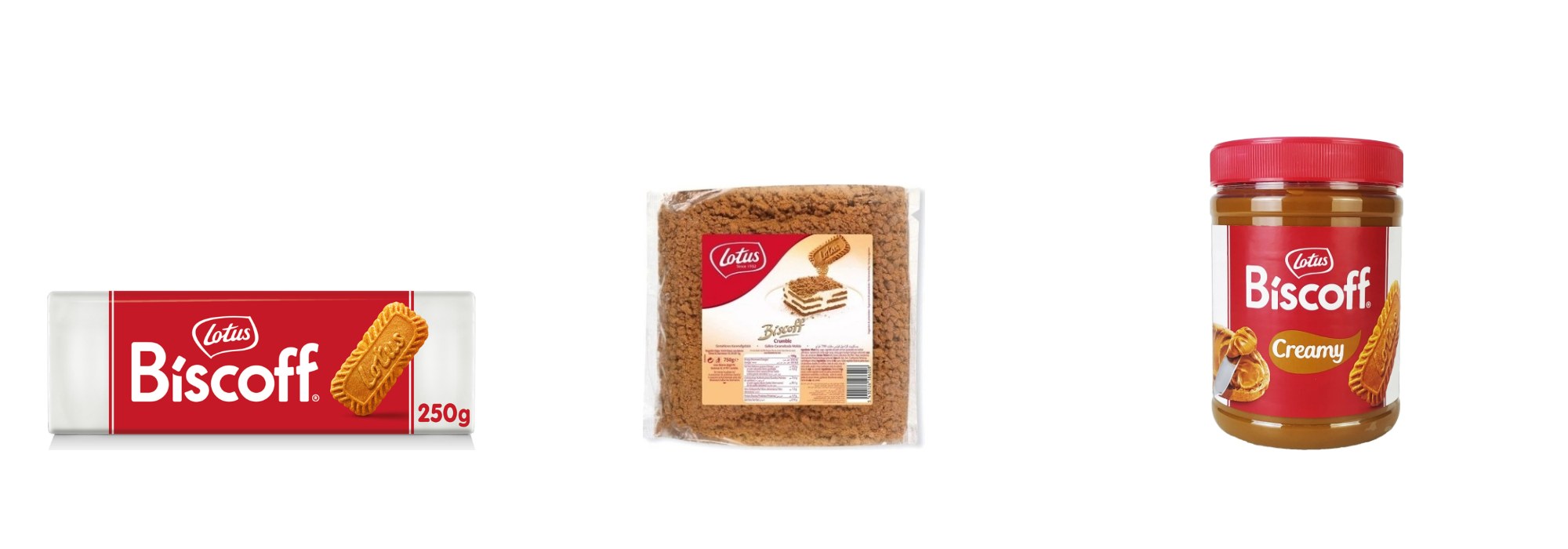
The Lotus Biscoff line at Santral Gıda
All six packages can be delivered on a single invoice and in a single shipment.
| Product | Packaging | Primary Use |
|---|---|---|
| Smooth Biscuit Cream 8 kg | Bucket | High-volume production, lowest unit cost |
| Spread Original 1600 G | PET jar | Point of sale, longest shelf life |
| Spreadable Spread 720 G | Glass jar | Breakfast presentation, boutique café |
| Topping Sauce 1 KG | Squeeze Bottle | Latte, milkshake, ice cream |
| Crumble 7.5 KG | Box | Cheesecake crust, topping |
| Biscoff Cookies 250 g | Package | With coffee, hotel breakfast |
You can view the entire product line on our Lotus brand page, and similar products in the Cookies & Snacks category.
Sources and Reliability Note
The packaging dimensions, shelf lives, cookie ratios (58% / 52%), heating instructions, allergen and vegan statements, recipe ratios, channel recommendations, and brand usage guidelines in this article are based on the manufacturer’s own publications (lotusbiscoff.com “Food Professionals” section, lotusbakeries.com corporate pages). The statement that “it has been scientifically proven that coffee and flavor profiles enhance each other” is attributed to Lotus; the company has not published the study on which it is based. Since there is no manufacturer’s statement regarding baking stability and dosage ratios, these details have not been included in this article.
Current product specifications may vary by batch and market; please refer to the packaging you received prior to menu labeling and allergen disclosure.
Get a wholesale price quote for Lotus Biscoff → Tell us your business type and approximate monthly consumption, and we’ll prepare a price list with packaging options tailored to your needs. Phone: 0212 614 74 80 · WhatsApp: 0533 788 55 76 · sales@santralgida.com


